Sunday, 13 April 2014

Be Kind To Your Spine:

Be Kind To Your Spine:
Too many times, people who experience spine pain say, “I wish I would have taken better care of myself when I was younger.” All of those accidental injuries from mistakes, rambunctiousness, and judgment errors do add up over a lifetime, leading to post-traumatic arthritis.
Because spine discs and ligaments have limited capabilities to heal after being injured, young athletes and adventurers often feel the effects of those injuries years later. Eventually, back and/or neck pain creeps into daily life. Specific activities like gymnastics and football are especially hard on the spine. Injuries often result from poor conditioning and risk-taking behavior. Counsel your children about making good decisions and proper conditioning techniques. Better yet, work with professionals that specialize in sports medicine, personal training and injury rehabilitation to ensure a pain-free future for your child.
Be kind to your spine now, and it will be kind to you in the future.
All of these spine care tips offer words of advice that should be passed along to children. If spine care education is not emphasized, spine pain will continue to be as common in the future as it is now. Furthermore, if general health education is not emphasized at an early age, our children will continue to suffer the consequences of preventable diseases, painful conditions, and poor health choices. Knowledge is power. Children are our future. So please pass the knowledge onto the next generation for the sake of our future

Saturday, 12 April 2014

Spondylosis

What is Spodylosis?
Spondylosis literally means stiffening or fixation of the bony building blocks of the spine (vertebrae) as the result of a disease process. Spondylosis refers to degenerative changes in the spine such as bone spurs and degenerating intervertebral discs. Spondylosis changes in the spine are frequently referred to as osteoarthritis.
Types of Spondylosis:
Spondylosis can occur in the cervical spine (neck), thoracic spine (upper and mid back), or lumbar spine (low back). Lumbar spondylosis and cervical spondylosis are the most common.
Spondylosis Causes and Risk Factors
Spondylosis is an aging phenomenon. With age, the bones and ligaments in the spine wear, leading to bone spurs (osteoarthritis). Also, the intervertebral discs degenerate and weaken, which can lead to disc herniation and bulging discs. Spondylosis is common. Symptoms are often first reported between the ages of 20 and 50. The rate at which spondylosis occurs is partly related to genetic predisposition as well as injury history.
Spondylosis Symptoms and Signs 
Characteristic findings of spondylosis can be visualized with X-ray tests. These findings include decrease in the disc space, bony spur formation at the upper or lower portions of the vertebrae, and calcium deposition where the vertebrae have been affected by degenerative inflammation.

Thursday, 10 April 2014

Self-Care at Home for Spondylosis:

Self-Care at Home for Spondylosis:

Home treatment is important in pain caused by spondylosis because pain may frequently improve or resolve after several days. Bed rest prolongs the time to recovery. Therefore, it is recommended to continue normal or near normal activities.

However, do not do anything that could exacerbate the problem, such as heavy lifting.
Some people find heat and/or ice to be helpful for back and neck pain caused by spondylosis.

Sleeping with a pillow between their legs may be helpful for low back pain. Special pillows to offer additional cervical spine support have been developed for neck pain.

Tuesday, 8 April 2014

Spinal Injuries and Children:

Spinal Injuries and Children:
Older children tend to be more aggressive in their activities and sports, thereby increasing the risk of injury to the bones, nerves and soft tissues in the spine. Teenagers are also more likely to test the limits of their bodies, often being exhorted by commercial advertising and/or peer pressure to push the envelope.
At this point, compression fractures are more commonplace, and we begin to see occasional disc injuries. Older pediatric patients also can injure the joints between vertebral bones, causing painful stress injuries. Only very rarely do the nerve roots become compromised in older children.
Slightly older children can be convinced to minimize their activity to speed up healing times for back pain, but then they frequently return to the same injurious behavior that caused the initial damage. Here, older kids may also find themselves the victims of their own intermittent inactivity and suffer overuse injuries, similar to an adult who is a “weekend warrior”.

Myth exploded:More youngsters suffer spinal injuries than older people

Generally it is believed that is among old people that most of the spinal injuries happen.Well, this is not true at all.Yes,among elderly the incidence of arthritis/osteoporosis are common but out of the total patients suffering from spinal injuries,roughly eighty percent are youngsters.This one fact is generally not much splashed.The common reason for spinal injuries in youngsters is accidents,injuries from heavy exercises and faulty life style.
Accident by nature can not be avoided.But certain precautions like wearing a seat belt while driving a car or wearing a well strapped helmet can help in cushioning the impact of any major crash.Similarly, when doing heavy exercises it should be done in the presence of an expert and secondly if the body is giving you uncomfortable signals,you should stop at that stage itself.
About faulty lifestyle ,this  definitely can be corrected.Faulty lifestyle includes  sedate life with hardly any physical exercise, sitting at desk for long hours and that too in a faulty posture.In addition having unhealthy eating habits like eating junk food harms further.
The cost of the young person suffering spinal injuries proves too high as he loses his mobility,which ultimately affects his capacity to work and earn.
So youngsters, should take care of themselves and avoid spinal injuries at all costs.

Monday, 7 April 2014

When to Seek Medical Care for Spondylosis?

When to Seek Medical Care for Spondylosis?

•If your pain is not manageable with the prescribed treatment
•For the development of acute nerve dysfunction, such weakness in one or more limbs (For example, see your doctor if your leg is weak and you are unable to flex your foot at the ankle or walk on your toes or heels.)
•Loss of bladder or bowel control, in the setting of acute back or neck pain, such as inability to start or stop urinating, can indicate a serious nerve dysfunction and should be evaluated at the emergency department immediately.
•Numbness in the groin area, or "saddle anesthesia," meaning numbness in the distribution where the bottom would contact a saddle. This can indicate a serious nerve dysfunction and should be evaluated at the emergency department immediately.
•If back or neck pain is associated with weight or fever greater than 100 F

Saturday, 5 April 2014

"Lift light and lift right"

"Lift light and lift right"

We all put immense stresses on our spine daily. Whether you are reaching into your car to pick-up a child, loading grocery bags into your trunk, or digging weeds in your yard, your back endures a daily assault-course. Each time we lift too much, or lift in an awkward way, we risk injury to our spine. To minimize your chances of injury from lifting, follow these easy steps:

If it seems too heavy, don't lift it! Get help!
Do not lift at arms length; always get close to the object.
When lifting or lowering an object, bend your hips and knees while keeping your back straight. This is known as the "power position". Do not hunch over an object, and never lift with straight legs while bending at the waist.
Never make sharp movements. Lift smoothly!
Never twist your back when moving an object. Move your feet instead!

Thursday, 3 April 2014

Ways to Minimize Failed Back Surgery Syndrome:

Ways to Minimize Failed Back Surgery Syndrome:


One of the biggest worries for most people considering back surgery is whether or not the surgery will actually work.When back surgery doesn't successfully alleviate the pain, it's known as failed back surgery syndrome (FBSS).Improve your chances of having a successful back surgery by following these five tips:

1.Be confident in your diagnosis:
Spine surgery is only indicated when there is an identifiable anatomical cause of spinal instability or a pinched nerve.
See What's a Herniated Disc, Pinched Nerve, Bulging Disc...?
The number one reason back surgeries are not successful is because of a misdiagnosis of the cause of back pain. Obviously, with a wrong diagnosis, a surgeon operates on the wrong part of the spine.Ask your surgeon how confident they are about their diagnosis of the source of your pain and about the specific area they will be addressing during the surgery.Also, ask your surgeon what the alternatives are to surgery and what would happen if you choose not to have surgery.f your surgeon is not confident with your diagnosis, or if they don't answer your questions to your satisfaction, consider getting a second opinion.See Getting an Accurate Back Pain DiagnosisRemember, if you are going to have surgery, you owe it to yourself to know that you're doing it for the right reason.

2.Trust your spine surgeon:
A good surgeon will be happy to answer any questions you have. If they seem irritated by your questions, this is a sign to reconsider allowing them to operate on you.
Ask your surgeon these questions:
How many times do you perform this particular type of surgery each year?
How have your other patients fared in the past following a similar surgery?
Do you have any patients who have had the same surgery and who would be willing to talk to me about their experiences?
Who would be assisting with the surgery?

3.Know the percentages:
Even in the best circumstances, spine surgery is not 100% guaranteed to be a success. Some surgeries are known to have more predictable outcomes than others.For example, discectomies and microdiscectomies are both used to treat lumbar herniated discs that are causing pain.Before the surgery, if the pain from the herniated disc is felt in the legs (known as sciatica), the surgery is known to be more successful than if the pain is felt in the lower Also, spine fusions for spinal instability from spondylolisthesis tend to be more successful than spine fusions for multi-level lumbar degenerative disc Knowing the success rate of your specific back surgery can provide you with a better idea of what outcome to expect.

4.Commit to a successful rehabilitation
The second most common reason a back surgery does not succeed is because of improper or inadequate rehabilitation after the surgery.Before you decide to have back surgery, make sure you understand all aspects of what your rehabilitation program will entail. A good way to gain a deep understanding of the projected schedule and timing is to speak to a physical therapist.Once you know all the details of your rehabilitation plan, ask yourself if you are dedicated and self-motivated enough to stick to it.

5.Feel confident in your decision and have a plan
By preparing thoroughly for back surgery beforehand, you'll have an easier recovery.Having confidence in your decision, making accommodations at work and in your family, and truly understanding the rehabilitation program will all help minimize the stress of having back surgery.Extensive research has shown that back patients' overall experiences and ultimate outcomes from back surgery can improve significantly with psychological preparation.

Stay Healthy!!Stay Fit!!

Tuesday, 1 April 2014

Sitting tips


The way we sit (specially when sitting at a strech) can determine how fast or slow our spine ages.
Read how these simple tips can help prevent back problem

Monday, 31 March 2014

Lower back pain

Lower back pain-
--Lower back pain is very common among adults and is often caused by overuse and muscle strain or injury. Treatment can help you stay as active as possible. And it will help you understand that some continued or repeated back pain is not surprising or dangerous.
--Most low back pain can get better if you stay active, avoid positions and activities that may increase or cause back pain, use ice, and take nonprescription pain relievers when you need them.
--When you no longer have acute pain, you may be ready for gentle strengthening exercises for your stomach, back, and legs, and perhaps for some stretching exercises. Exercise may not only help decrease low back pain, but it may also help you recover faster, prevent reinjury to your back, and reduce the risk of disability from back pain.
--Exercises to reduce low back pain are not complicated and can be done at home without any special equipment.
--It's important that you don't let fear of pain keep you from trying gentle activity. You should try to be active soon after noticing pain, and gradually increase your activity level. Too little activity can lead to loss of flexibility, strength, and endurance, and then to more pain.

Friday, 28 March 2014

Spine Diseases

Spinal disease is any pathology which affects the spinal column and/or the spinal cord and spinal nerves which are contained therein. Spine disease is a large area of study because of the large number of diseases which can affect the spinal system, from purely skeletal disorders to primary nervous system disorders. All types of spine disease can present with either or both spinal symptoms or neurological symptoms associated with injury or compression of the spinal cord or spinal nerves. Spine disease is very common, with many people undergoing spinal surgery every day.

Degenerative spine disease is a general term for any pathology of the spine that occurs over time due to both normal aging and wear and tear of the vertebral column. This includes many pathologies, such as herniated disc disease, spinal stenosis, and spinal instability.

Traumatic spine disease refers to any disease of the spine which occurs as the result of a traumatic injury such as a fall or motor vehicle accident. It can include spinal fractures, traumatic disc herniation and spinal instability.

Spinal Tumors are tumors that involve the spinal cord or vertebral column. They can either be primary, originating in the spinal column, or secondary, spreading to the spine from other sites in the body, such as in the case of a metastatic cancer.


Spinal Dysraphisms are abnormalities in the the spinal cord, mostly due to abnormalities in the development of the spinal cord and/or vertebral column.

Treatment of spondylosis

Treatment of spondylosis:
Doctors usually recommend muscle relaxants and non-steroidal anti-inflammatory medications such as ibuprofen and naproxen to relieve the pain and stiffness. This is often combined with physiotherapy to stretch and strengthen the spine and lower back and neck muscles.
Surgery to remove bone spurs or affected discs is recommended for patients experiencing severe neurological problems such as weakness, pain and numbness in the arms and legs.
“Spinal problems caused by cervical and lumbar spondylosis are not life-threatening, but if left untreated, can lead to increased pain and decreased flexibility and mobility,” says A/Prof Tan. When nerves are pinched, damage to them often occurs, resulting in permanent pain, numbness, weakness or poor coordination.
Advances in medical technology have made minimally invasive spinal surgeries possible even for patients with severe spondylosis. These patients can expect less post-operative pain and faster recovery, A/Prof Tan adds.
Cutting-edge medical technology – including minimally-invasive surgery – and the expertise of its specialists make the Department of Orthopaedic Surgery at Singapore General Hospital a premier referral centre for spinal surgery, joint replacement and ankle and foot surgery, and the treatment of musculoskeletal tumours, trauma and sports-related injuries.

Wednesday, 26 March 2014

Spinal Cord Diseases

Spinal Cord Diseases
Your spinal cord is a bundle of nerves that runs down the middle of your back. It carries signals back and forth between your body and your brain. It is protected by your vertebrae, which are the bone disks that make up your spine. If you have an accident that damages the vertebrae or other parts of the spine, this can also injure the spinal cord.
Other spinal cord problems include
-Tumors
-Infections such as meningitis and polio
-Inflammatory diseases
-Autoimmune diseases
-Degenerative diseases such as amyotrophic lateral sclerosis and spinal muscular atrophy
Symptoms vary but might include pain, numbness, loss of sensation and muscle weakness. These symptoms can occur around the spinal cord, and also in other areas such as your arms and legs. Treatments often include medicines and surgery

Tuesday, 25 March 2014

Tips for a Healthy Spine


1) Sleeping - Never on your belly! Side is acceptable but on your back is the best. Use one pillow and don't prop your head up.

2) Pillows - Cervical (contour) pillows are the best to support your neck properly

3) Mattresses - Firm mattresses are better than soft - no pillow tops.

4) Sitting - Avoid sitting for more than 45 minutes. Get up frequently. Sit with your legs underneath your chair and not with your legs crossed.

5) Computers - Your screen should be eye level. If it's too low, you will hunch over too much

6) Lifting - Lift with your back straight and bend your knees.
7) Wallets - You should not sit with wallet in your back pocket. It can cause pelvic misalignment as well as pressure on the sciatic nerve.

8) Purses/Handbags - Avoid carrying them on one shoulder. Slinging them with the strap on the opposite should can help. The best is to go light and carry them in your hand alternating sides often.

9) Footware - Purchase good supportive footware with adequate arch support

10) Orthotics - Most people have faulty foot posture that will eventually cause back problems. If you have fallen arches you should consider getting orthotics. Ask one of the GRC doctors.

Friday, 21 March 2014

Back extensions-

Back extensions-

Stretches and mobilises the spine backwards

Start position:
Lie on your stomach, and prop yourself on your elbows, lengthening your spine. Keep your shoulders back and neck long.

Action:
Keeping your neck long, arch your back up by pushing down on your hands. You should feel a gentle stretch in the stomach muscles as you arch backwards. Breathe and hold for five to 10 seconds. Return to the starting position.
Repeat eight to 10 times.

Tips:
Don't bend your neck backwards.
Keep your hips grounded.

Thursday, 20 March 2014

KNEE ROLLS


Knee rolls

Start position:
Lie on your back. Place a small flat cushion or book under your head. Keep your knees bent and together. Keep your upper body relaxed and your chin gently tucked in.

Action: 
Roll your knees to one side, followed by your pelvis, keeping both shoulders on the floor. Hold the stretch for one deep breath and return to the starting position
Repeat eight to 10 times, alternating sides.

Tips:
Only move as far as feels comfortable.
Place a pillow between your knees for comfort.

Wednesday, 19 March 2014

SPINE EXERCISES: Bottom to heels stretch


SPINE EXERCISES: Bottom to heels stretch

Stretches and mobilises the spine

Start position: 
Kneel on all fours, with your knees under hips and hands under shoulders. Don't over-arch your lower back. Keep your neck long, your shoulders back and don't lock your elbows.

Action: Slowly take your bottom backwards, maintaining the natural curve in the spine. Hold the stretch for one deep breath and return to the starting position.
Repeat eight to 10 times.

Tips:
Avoid sitting back on your heels if you have a knee problem.
Ensure correct positioning with the help of a mirror.
Only stretch as far as feels comfortable.


Tuesday, 18 March 2014

Break Up Tension with the Cat-Cow Stretch-


Come to a four pointed kneeling position. Stack your shoulders directly above your wrists, and place your knees on the floor slightly behind your hips. Exhale and round your spine. As you do this press outward through your hands and roll your tailbone under (toward your forehead) to lengthen your lower back. Inhale, arch your spine in the other direction by lifting your tailbone upward as you curl your chin backward. Repeat for 30 full rounds of breath.

Monday, 17 March 2014

Exercise : Chest Raises from Prone

Exercise : Chest Raises from Prone

-This is a more advanced exercise. Not everyone will be able to do this one. If you can lie on your stomach without difficulty, you can safely try this one.
-Lie on stomach on bed or floor.
-Putting a pillow under stomach is optional and makes it easier to get on stomach and lift head.
-Pinch shoulders back, smoothly lift head and chest and continue to look straight down.
-Hold for a slow 5 count.
-Rest for 2 seconds and repeat until tired.
-Do once every day.

Suggestion: If you can get on your stomach but can’t lift your head up, keep trying it. You might eventually start getting your head and chest up, and then you’ll know your exercises are helping!

Friday, 14 March 2014

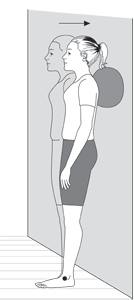
EXERCISE: Strengthning Extensor muscles


EXERCISE: Strengthning Extensor muscles 

-Stand straight in good posture.
-Place ball behind upper back.
-Keep feet apart and away from wall for good balance.
-Push hard with feet and legs to press back against ball.
-Keep spine, hips and knees in the same position. Only the ankle joints pivot where shown by dot.
-Hold for a slow 5 count and follow with a 2 second rest.
-Repeat until you feel your leg or back muscles tire.
-Slowly increase up to 15–20 repetitions.
Do once every day.
-As strength increases move feet further away from the wall to push harder. Remember don’t let your spine bend.

Thursday, 13 March 2014

Spine transplant:A boon to mankind

We have all heard about Heart and Liver transplant which in their own way have revolutionised medical treatment.Equally revolutionary is Spine Transplant on which not much has been talked in the public sphere.Earlier Disc transplant used to be a fusion surgery which definitely used to remove the pain but the patients mobility was greatly reduced.Now a days, an artificial instrument is transplanted into the spine which not just removes the pain but continues to do the actual disc job like carrying load ,providing flexibility.
It has come as a big relief for young patients who suffer damage in spine in some serious accident.Also it greatly helps those suffering from paralysis of spine.All in all its a great boon for those suffering from serious spinal problem

Wednesday, 12 March 2014

EXERCISE: neck press against resistance

EXERCISE TIME:

Neck Press Against Resistance-

--Lie on back with pillow under head to support in neutral position.
--Push head down firmly to straighten and lengthen spine as shown.
--Keep chin tucked and head facing upward.
--Hold for a slow 5 count.
--Relax for a couple of seconds.
--Repeat 10 times or until neck muscles tire.
--Do once in the morning and once in the evening every day—perhaps before getting up and going to bed at night.

Suggestions:
--While doing these exercises tighten and relax muscles smoothly—don’t jerk or apply sudden forces.
--This exercise may become easy after a while. If so, replace pillow(s) with a firm rolled towel. It should fit comfortably behind your upper neck and base of the head supporting your head in a comfortable neutral position.

Tuesday, 11 March 2014

Sitting Postures for office chairs:

Sitting Postures for office chairs:

--Be sure the back is aligned against the back of the office chair. Avoid slouching or leaning forward, especially when tired from sitting in the office chair for long periods

--For long term sitting, such as in an office chair, be sure the chair is ergonomically designed to properly support the back and that it is a custom fit

--When sitting on an office chair at a desk, arms should be flexed at a 75 to 90 degree angle at the elbows. If this is not the case, the office chair should be adjusted accordingly

--Knees should be even with the hips, or slightly higher when sitting in the office chair

--Keep both feet flat on the floor. If there's a problem with feet reaching the floor comfortably, a footrest can be used along with the office chair

--Sit in the office chair with shoulders straight

--Don't sit in one place for too long, even in ergonomic office chairs that have good back support. Get up and walk around and stretch as needed

Monday, 10 March 2014

Care for your spine


Care for your spine:

When you consider your body’s healthy habits (or not so healthy habits) start to think of a freshly ironed white shirt, with long sleeves. Take the same shirt and tie it up tight, in a knot. When you wake up tomorrow morning, which one do you want to wear to greet the day?

Now, think about how many activities during the day affect your back, neck, shoulders, arms, and your spine. How does crossing your legs or slumping in a chair hurt your back and add to the pain and discomfort you experience every day? These habits may restrict your body from receiving all the blood, oxygen, and nutrients it needs to function at its best level.

Most of us forget that daily activities impact our body and many of us have developed habits that, when identified and corrected, will be replaced with healthy alternatives. These tips will begin to help you understand how to maintain your healthy spine, to improve your neck and back, and to reduce these habits that impact your body.

These are habits that affect the direct relationship of your spine to your pain. When you become aware of what you are doing, you might want to write it down on paper. Place the note on your desktop or in your office as a reminder. When you are successful, cross a bad habit off this list and replace it with a new achievement:

--Walk ½ mile each morning
--Swim ten laps
--Have broccoli with dinner
--Replace each old bad habit with a healthy new habit.
--Take baby steps toward your healthier back, neck and spine.
--Avoid habits like crossing your legs while at your desk, bending your head down while at the computer, and avoid holding the desktop phone against your shoulder.
--Begin to practice these tips, one each day.
--Write down your old habit to be eliminated. Then write a healthy habit to replace it.
--Be specific. Instead of writing, “I’ll exercise.”
--Think about a specific exercise. “I’ll walk around my backyard for five minutes in the morning.”

Friday, 7 March 2014

Weight Loss for Back Pain Relief

Weight Loss for Back Pain Relief-

-Patients who are overweight or obese and suffer from back pain may not be aware that their excess weight is actually contributing to their back pain.

-While it has not been thoroughly studied exactly how excess weight can cause or contribute to back pain, it is known that people who are overweight often are at greater risk for back pain, joint pain and muscle strain than those who are not obese.

-In addition to back pain, symptoms exhibited by persons who are obese or severely overweight may include fatigue, as well as difficulty breathing and shortness of breath during short periods of exercise.

-If the fatigue and shortness of breath causes one to avoid activity and exercise, then this can indirectly lead to back pain as lack of exercise contributes to many common forms of back pain.

How Obesity Leads to Back Pain:
-According to the American Obesity Association, episodes of musculoskeletal pain, and specifically back pain, are prevalent among the nearly one-third of Americans who are classified as obese.

-Some of the most common obesity-related problems include musculoskeletal and joint related pain.1 For people who are overweight, attention to overall weight loss is important as every pound adds strain to the muscles and ligaments in the back.

-In order to compensate for extra weight, the spine can become tilted and stressed unevenly. As a result, over time, the back may lose its proper support and an unnatural curvature of the spine may develop.

-In particular, pain and problems in the low back may be aggravated by obesity. This occurs for people with extra weight in their stomachs because the excess weight pulls the pelvis forward and strains the lower back, creating lower back pain. According to the American Obesity Association, women who are obese or who have a large waist size are particularly at risk for lower back pain.1

Identifying the Need for Weight Loss :
-Body Mass Index (BMI) is a measure commonly used by medical practitioners. BMI is a mathematical formula (BMI=kg/m2) that takes into account a person’s weight in kilograms and height in meters and calculates a number. The higher a person’s BMI falls on a pre-determined range of values, the higher the likelihood for obesity.

-Although there is some debate over the specific meaning of BMI measurements, a BMI of 30 or higher is typically considered to be obese, while a measure of 25 to 29.9 is typically considered to be overweight.

-It is also important to evaluate where excess fat is carried on the patient’s body. Patients who carry more weight around their midsection are at greater risk for obesity-related health problems, such as low back pain. Weight loss for health considerations is often advisable for women with a waist measurement of more than 35 inches or men with a waist measurement of more than 40 inches.

Degenerative Disc Disease-

Degenerative Disc Disease-

Normally, the spine and all its ligaments and muscular support are stable, only moving in certain ways. However, with severe degenerative disc disease, the normal stability of a spine can become lax and lead to abnormal weakness in certain areas. Instability can both lead to pain as well as injury to the spinal cord or spinal nerves, both of which can cause neurological symptoms. Instability can also occur as the result of a trauma which tears supportive soft tissues or breaks bones of the spine.

Symptoms-
-Lower back pain that is generally made worse with sitting
-Back pain intensified by bending, lifting and twisting
-Walking and running may feel better than prolonged sitting or standing
-Desire to change positions frequently so alleviate pain

Treatment-
Treatment for degenerative spine disease varies considerably depending on the specifics of each case. Some patients benefit from conservative therapy with rest and physical therapy and some cases call for spine surgery. The faculty of the Spine Institute will prescribe a path of treatment that is unique to each patient and their particular condition.

Tuesday, 4 March 2014

SPINAL FUSION

Spinal fusion is surgery to permanently join together two or more bones in the spine so there is no movement between them. These bones are called vertebrae.

ABOUT SPINAL FUSION:
-You will be asleep and feel no pain (general anesthesia).The doctor will make a surgical cut (incision) to view the spine. This may be done:

-On your back or neck over the spine. You will be lying face down. Muscles and tissue will be separated to expose the spine.
On one side of your belly, if you are having surgery on your lower back. The surgeon will use tools called retractors to gently separate, hold the soft tissues and blood vessels apart, and have room to work.

-With a cut on the front of the neck, toward the side.
Other surgery, such as a diskectomy, laminectomy, or a foraminotomy, is almost always done first.

-The surgeon will use a graft (such as bone) to hold (or fuse) the bones together permanently. There are several ways of fusing vertebrae together:

-Strips of bone graft material may be placed over the back part of the spine.

-Bone graft material may be placed between the vertebrae.
Special cages may be placed between the vertebrae. These cages are packed with bone graft material.
The surgeon may get the graft from different places:

-From another part of your body (usually around your pelvic bone). This is called an autograft. Your surgeon will make a small cut over your hip and remove some bone from the back of the rim of the pelvis.

-From a bone bank. This is called an allograft.

-A synthetic bone substitute can also be used.
The vertebrae may also fixed together with rods, screws, plates, or cages. They are used to keep the vertebrae from moving until the bone grafts are fully healed.

-Surgery can take 3 to 4 hours.

Monday, 3 March 2014

Artificial Disc Replacement :


A rapidly developing alternative to spinal fusion surgery, artificial disc replacement is a procedure that involves replacing a painful disc that is causing chronic back pain with an artificial disc that provides pain relief without compromising the spine's natural anatomical structure. Artificial disc replacement surgery may be performed on the lower back (lumbar spine) or the neck (cervical spine). Artificial discs are structurally similar to the damaged discs that are replaced and share similar functions, including acting as shock absorbers in the back or neck.

Sunday, 2 March 2014

Non-surgical Treatment for Spinal Stenosis

1.Exercises:
Although a suitable program of spinal stenosis exercises may be helpful in the hands of a good physical therapist, it is not curative. Even though stenosis exercises are not a cure, however, it is very important for patients to remain active as tolerated and not additionally debilitated from inactivity; therefore, an appropriate spinal stenosis exercise program is a key part of any treatment program.


2.Activity modification.:
With this treatment for stenosis, patients are usually counseled to avoid activities that cause adverse spinal stenosis symptoms. Patients are typically more comfortable while flexed forward. Examples of activity modification for treatment of spinal stenosis might include: walking while bent over and leaning on a walker or shopping cart instead of walking upright; stationary biking (leaning forward on the handlebars) instead of walking for exercise; sitting in a recliner instead of on a straight-back chair.